Thursday, June 5, 2014

Tree Spirits: The Nurturer of Harmony

Fern Gully: The Last Rainforest is an animated movie about the fragility of our natural ecosystems.  The movie follows Christa a fairy who does  not believe that humans are extinct or something told only in fair tales.  One day a bat who claims was tested upon by humans tells Christa that humans are very well alive and that Christa should stay away from them.  Christa, in her curiosity, goes out to search for these humans and she eventually follows the smoke to find humans marking territory.  One of the humans, Zack, accidentally marks a tree where a great evil, Hexus, was once hidden away by Maggie.  In order to protect Zack, Christa changes the size of the human through which the human is able to explore the forest.

In order to change Zack back they embark on an adventure to go see Maggie.  Meanwhile, Hexus is released by the other humans.  Eventually all the fairies and Zack realize that humans are not here to protect the forest instead they have destroyed large swaths of the land by cutting down the trees.  Within moments Hexus and the humans reach to clear the last piece of land that there is.  Thanks to the bravery of Zach the tree cutting machine is stopped and Hexus starts to dissipate.  However, Nexus only returns more powerful than aever and it takes Christa realizing the extent of her power to ultimately defeat Hexus.

In the end Zack returns to his normal size and decides to stop further destruction of the rain forest and regrow what has been lost.

The movie shows how significant our human activities are.  What takes thousands of years to grow is destroyed within minutes by humans.

Wednesday, June 4, 2014

The Story is in the Ice


The bigger picture is the picture that we always told to consider.  Chasing Ice is a documentary by Jeff Orlowski which focuses on the photography of James Balog and the story which it tells.  Balog believes that is not numbers or figures that can convince people, it is visual evidence that will make people see and listen. Balog wanted to capture the affects of global warming and he believed that capturing ice and the melting of ice would be the best way to get an audience to believe in the impacts of global warming. There have been more rare events occurring and most scientists attribute these events to warming global temperatures. The photography gives us a glimpse of what we are having to face on planet Earth.

One of the locations where Balog decided to take pictures was Greenland.  In Greenland he witnessed the glaciers calving which is a normal process in which glaciers split.  However, one thing he pointed out was that the whole ice sheet of Greenland is thinning.  Within one hour of a location in which they decided to take photos they witnessed a an ice chunk the size of a few football fields collapse and rotate.  In total they installed about a dozen cameras throughout Greenland, about 5 in Iceland, 5 in Alaska, and 2 in Montana.  

Balog describes some of the dangerous conditions in which he had to go through.  For example, the water in the areas where he works is so cold that in it he can only function for about 5 minutes until his body starts taking a toll.  There are also technical failures such as problems with timers which setback real work from getting done.  While some cameras turned out to be unreliable others were able to take breathtaking photos.  One thing Balog noted was that many of these landscapes may not occur again.  One glacier, for example, has retreated nearly 11 miles and has thinned by about the height of the Empire State Building.  In the glaciers of Greenland was Cryoconite which is a combination of natural dust from central Asia, carbon, and algae.  This forms a black substance on glaciers.  Since it is black it absorbs more of the sunlight thus warming the surrounding area.  Eventually, these holes get bigger and melt more of the ice.  Melting such as this can increase sea levels by 1.5-3 feet of water.

Balog captured just how much of a difference there has been in glaciers in short periods of time.  Using time lapses we can see how deflation slowly takes place.  Rivers are formed and the rocks and ice tumble and the heat cause them to melt away.  Some glaciers are retreating so rapidly that the cameras had to be re- positioned because the glacier moved beyond the frame of the camera.  As Balog says glaciers are like a canary in a coal mine.  They are foretelling the deterioration of the environment.

It is true that some glaciers are getting bigger.  However in the movie they use the example of the Yukon Glaciers.  Within 50 years only 4 of the about 1400 glaciers got bigger, over 300 dissipated, and nearly all the rest got smaller.  Balog's team was able to capture the biggest calving event ever recorded on camera which lasted nearly 75 minutes.  

One of the main problems, according to Balog, is perception.  Not enough people recognize what is happening and he is attempting to spread the message using pictures.

Tapped Out of the Water Tap

Mahatma Gandhi once said "There is enough water for human need, but not for human greed".  If you were to tell people a few decades back that while most people have access to a fresh water, they still drink bottled water they would probably not understand why we would do such a thing.  Do we understand why we decide not to drink tap water and spend insane amounts of money on water bottles?  By the year 2030 2/3 of the world will have a limited supply of drinkable water.  Water has become a commodity which has led to corporate control on water.  This may answer that question to some extent.  Since it has become a corporate issue profits mean that the public must remain interested in bottled water and continue to consume it in order to ensure profits.

Tapped a documentary about bottled water goes deeper into the issue of bottled water and what it does to communities.  One of the focuses of the documentary is defining who has the rights to the water.  Since, water is a basic human right, the movie asks, why is it able to be controlled by one major corporation.
Local communities feel they are outnumbered and outgunned.  Some believe it is a corrupted process.  One example was that a nursing home was not able to access water and needed fire trucks to bring in water while Nestle simply kept on pumping more and more water.  Many citizens of small towns have tried to stop big companies from abusing the natural resources of their small towns and cities.  However, when a billion dollar company is in the neighborhood it is hard to get much accomplished.

Companies have a tendency to worry about profits over environmental  sustainability.  In North Carolina, when they were facing a drought, Pepsi continued its bottled water operations even at the height of the drought.  About 400,000 bottles were bottled every single day.  There was not even a temporary halt despite that the state was running out of water.  Many states which once believed they had plentiful water found out how wrong they were such as Atlanta, Georgia.  In states such as these normal citizens are told to limit their usage of water.  However, large companies continue their everyday operations and ship this water throughout the country.

According to Joe Doss who is the president and CEO of International Water bottled water only accounts for 0.02 percent of groundwater; however, this extraction takes place in select areas which amplifies the affect of water extraction in that area.  In addition, local habitats are being destroyed by these water companies.  As we have learned in class, plastic is not biodegradable.  The same locations where water is being bottled the trash, plastic bottles, now pollute the water supply.  Once healthy communities of lakes and rivers have now become fragile.

Bottled water is bad not only for the environment but also for our wallets.  The water market is a $800 billion industry.  Bottled water is sold at 1900 times the price that tap water costs.  This trend started in the 1970's with the introduction of Perrier.  In 1989 plastic bottles came into the market and ever since then water bottles have become more trendy.  What bottled water does is it provide convenience and individualization.  Also adding the fact that millions has been spent on advertising, of course people are buying more water.  It is this convenience that people are really paying for.  In fact much of the water that is bottled is simple tap water which is being bottled and being sold for a profit.

We all know that plastic itself isn't exactly pure natural substance.  Plastic itself contains many different types of chemicals which can potentially have an adverse effect of the water inside the bottle.  We are still unaware if the contents of a plastic bottle can produce unhealthy affects or not.  There are many chemicals in bottles which contain controversial ingredients which harm the environment and pose a danger to pregnant women, children, and many others.  Some bottled water has actually had to be recalled because it was it had contents such as microorganisms which could make people sick.  In fact, 714 million gallons of oil are used to create all the plastic water bottles annually.  The plastic manufacturing itself has a negative effect on its local communities.  People within the community are becoming sick from the by products of making the plastic.
Many scientists have repeatedly voiced their concerns and conducted studies of the chemicals in water bottles which are potentially dangerous.

In America only about 20% of our beverage containers are recycled.  This is less than the worldwide average of 50 percent.  One way to encourage recycling is by having a tax on bottles.  I have found this system to be quite effective.  People are encouraged to recycle because of a financial incentive.  Even if someone doesn't care about the five cents well there are other people that do.  One thing I have personally noticed is that many individuals such as students and homeless people actually go around the city and pick up bottles!  What a smart way to reduce our pollution?  These people have an incentive to pick up every single bottle they see and they will even help us make sure that bottles thrown in a general trashcan are taken out and recycled properly.  When I visited India, where there are little to no recycling initiatives, you will see that people will throw bottles just about anywhere whether it be the beach or into some mountain ravine.Perhaps we should increase incentives such as these in other states and countries.

This documentary shows us that a basic human right has become a basic human commodity.  Pretty soon we may begin to see bottled air.  Their are many apparent dangers of water bottles over all stemming from the plastic to where it is bottled.  While I will not eliminate my usage of water bottles entirely I will definitely try to avoid using plastic water bottles after discovering the possible dangers that it contains.

Attack on the Farmageddon

There are different types of calamities that we must face when it comes to food security.  Many of us are aware that perfectly good food is wasted everyday.  Farmageddon: The Truth About the Food Industry directed by Kristin Canty shows another way which food is wasted under pretenses to protect certain organizations.
One of the driving points of Farmageddon is that we are disregarding thousands of years of human experience with agriculture and animal husbandry.  Instead, the government is promoting regulations and policies which put smaller farms at a disadvantage.  For example, small farmers have to go through an inconvenient amount of paperwork in order to be able to sell their produce.  Are the farmers supposed to farm or should they be required to go through an unreasonable amount of bureaucracy?

There is also a certain amount of bullying that smaller farmers have to face.  For example, a family farm which was milking European sheep had to face tests and waiting periods to be able to use their sheep.  These sheep were eventually slaughtered under false pretenses.  These farmers were threatened  and warned not to go to the media or speak about the issue to anyone otherwise the farm would be shut down.  The owner of this farm believed that the power is in the reigns of the people who have the money such as the packers and slaughters.  Eventually it was found these sheep had no connection to Mad Cow's disease or any way that they could be related to the disease.
According to the movie we have seen many of the small family farms be replaced by large farms due to government policies.  For example, 88 percent of the dairy farms have been shut down.  By favoring processed food instead of a more natural diet we see that 70 percent of the country has become obese.  What I found surprising is that raw milk does make your body stronger such as helping people with asthma and allergies.  It would make sense since humans have been drinking this type of milk for thousands of years.  However, we have been led to believe that if we do not drink pasteurized milk then it is not safe for us. Thus, while we are allowed to eat fast food, smoke, and consume other harmful substances we are "protected" from consuming raw milk.  The only farm crop more regulated than raw milk is marijuana.  Is something that we have been consuming for so many thousands of years suddenly so harmful?
What many want is the simple choice to understand what raw and pasteurized milk are.  If they so decide that raw milk is better then they should have the ability to buy and consume such milk.

An interesting fact for me is that if raw milk is legal to sell and consume in some states then it is still illegal to transport it across state borders even for personal consumption.  When I first heard this I thought of alcohol and even that is legal to transport across state borders.  In fact people do it regularly to save on taxes in some states.  There have also been a lot of raids on farms with suspicion of having the ability to sell raw milk.

There are many chemicals we can avoid consuming.  Chickens in big farms are forced to live in small confinements where they live with their own excrement.  Since many of these areas are unhygienic and not cleaned properly the chickens end up breathing in the evaporated feces.  This is one reason so many antibiotics are needed to give chickens.  I was surprised to see what a real grass-fed, free range chicken looks like.  While I may be a vegetarian I still have reason to be concerned about the eggs which these chickens produce.  While small farms are being put through inconveniences, there are many citizens who are concerned that the United States Department of Agriculture(USDA) is not doing enough to actually inspect the food.  Instead, farmers are just having to do formalities while nothing is actually being accomplished.  

Obviously, we all want to be able to consume healthy and safe food.  However, we are not even doing that right now.  The processed food which we eat now, though the effects are not immediate, is detrimental to our bodies and our society.  As California moves towards legalizing marijuana for recreational use will we legalize raw milk.  As Ron Paul says in the conclusion of the documentary, it is up to the people to get fed up and make it in Congress' favor to produce change.

Tuesday, June 3, 2014

The One Which Ties Them All

In environmental science there are multiple pressing issues which we, as residents of planet Earth, have to face in order to ensure the long term sustainability of our planet.  Throughout the semester I have learned about many of these issues and come to realize the importance of being aware of not only how the global community is affecting the environment, but also how as an individual I am affecting mother nature.

Courtesy of destination360.com

If I were to pick the single most important environmental issue it would be pollution caused by humans.  There is no doubt that humans have more of an impact on our local environment than any other species combined.  The reason I consider pollution to be the greatest environmental issue is because it the cause, directly or indirectly, to all the other major environmental issues.  For example, our gas emissions are driving global warming.  The different types of toxic chemicals which we dump into our water systems is driving species to extinction.  The different types of nuclear tests we have conducted have driven organisms to have mutations.

As a society is our responsibility to stop ourselves from from slowly devastating our environment.  Some of the many actions we can take is advocate for cleaner regulations on the political level.  If some of our policies were to change then it would greatly reduce the negative impact that we have on the world.  If certain companies and other organizations continue to behave in a detrimental behavior then we can use the greatest power in the world to make them change their ways, money.  By appropriating our money responsibly we can punish those who punish the environment and reward those which are more sustainable in their practices.

Courtesy of tgeink.com

Many of the factors that affect and changes I suggested are on the macroeconomic level.  However, change starts at home with the individual.  The average American produce about 4.5 pounds of trash a day.  If we can't change our own habits then how can we expect larger organizations to?  As an individual some of the actions which I can take is to reduce the amount of plastic I use.  Now this a statement when stated usually means plastic bottles.  But as I learned in class even small items such as straws contribute greatly to the amount of pollution which we produce.  So by reducing or eliminating items such as those I can help reduce the severity of this issue.  Another act I can take is by reducing other resources.  Reducing warm showers means less energy required to heat up the water.  Consuming locally grown food equates to less energy needed for the transportation, less energy and chemicals needed to grow food, and overall healthier food.  Changes such as these can be done by individuals and produce real change.

Courtesy of californiathroughmylens.com

Throughout the course I gained various different types of knowledge.  I learned that my phone had gold and had components and constructional parts from nearly all the continents of the world.  I also learned the extent of our subsidies for major farms and crops such as corn.  It is due to these subsidies that we have an abundance of corn.  Locally, I discovered something called  Community Supported Agriculture(CSA) which provide fresh food to local residents.  This is something which I have personally become interested in. Going further into food I was surprised at how much food we truly wasted and much of this food was perfectly edible food. Perhaps one of my greatest educational moments of the class was that as country we can never really be energy independent because we would also want to see energy to other countries in order to grow business here.  

Courtesy of Flickr

While much of the information I came across in the class was not new, it was the fact that we went in-depth that I really learned a little about how our economic, political, and cultural systems work in regards to the environment.  I intend to use many of the new types of information and opportunities which I learned about in my personal everyday practices.


Wednesday, May 28, 2014

A Possible Escape in the Event of the Rise of the Walking Dead

On May 17th I awoke from my slumber in order to examine a local farm which, from what I had heard, still practiced the "old ways".  This was not one of the big farms where much of my produce came from.  Nor was it a farm located somewhere in Chile where my food had to be traverse distant lands through various modes of transportation.  No, this was a small local farm which I have always believed to be an expensive venture into environmentally conscious eating.

When we reached the farm we were greeted by a student who also attended the same college as myself.  This really showed how locally supported the farm was.  This student who also worked on the farm gave us a tour of the various components which comprised the farm.  Much of what the student reiterated was that this farm was indeed one which the local residents would come and work in.  Local restaurants would purchase their produce in order to supply their customers with fresh produce.  The chickens were not kept in small cages where they had to have their claws removed to prevent from injuring each other.  Instead, they were allowed to roam within an enclosed area.  There were even some that were free range.

One of the biggest surprises for me was the various types of pigs which were present.  I had assumed that all pigs which were used for consumption were the big pink ones.  However, there were pigs of different pigmentation and different sizes abound at the farm.  There were also various types of cows some from milking and some which would be for consumption.  The tour guide clarified that if a cow is for milking it is not slaughtered for consumption.

Some of the practices that the farm engaged in included composting.  The dead waste products of the produce and the manure of the live animals was reused to fertilize the soil.  This component was one of the aspects which made the farm so sustainable.  In comparison to big farms where they use pesticides and herbicides to kill insects and other pests, at Amy's farm they actually wanted more insects to be present in the farm.  Insects determined the healthiness of farms.

The owner attempted to be as sustainable as possible.  He avoided using plastic to help the plants grow and instead experimented different ways to promote healthy agriculture.  The farm also planted certain crops at different times in the year according to the seasons.  This was a natural way of growing and did not require excess resources for a product which was not meant to grow at that time.  Some sustainable methods which the farm had not implemented as of date was a system to reuse water.

As someone who is always curious about the finances of a situation decided to look at how the farm was able to sustain itself financially.  The farm was not subsidized by the government unlike big farms.  To compensate for this the farm sold its own produce to local residents at a higher price.  One way that the farm did save money was by using volunteer labor.  As stated by our tour guide these volunteers were given an abundance of food that they helped grow to compensate them for their efforts.  Another way was having locals pitch in to take care of some of the livestock such as cows.    Their would be about 16 people who would collectively take care of a cow financially, and in the end they would receive some of the produce from the cow.

In all aspects Amy's farm is a sustainable farm which is able to thrive by remaining local.  The work they do reduces the amount of pollution produced drastically since they do not use harmful chemicals and their produce does not have to travel hundreds of miles and touch numerous hands to finally get on a plate.  After visiting this farm I am more interested in volunteering at a local farm and even being a part of a local CSA.

Tuesday, May 27, 2014

Let it Go, Let it Go, The Heat Never Bothered Me Anyways

Thousands and even hundreds of years ago the human species roamed the planet with one goal in mind, survival.  Fast forward to the future and we discover that our very survival depends on the availability of energy and technology.  In fact, widespread loss of electricity is considered just as dangerous as the use of a weapon of mass destruction.  Humans simply can not live without electricity!

So, one can imagine how detrimental to my living it must have been the decision to limit my energy usage for a 24 hour period.  As a way to make it less burdensome for myself I decided to have the 24 hour period a day where my commitments would be least affected, which happened to be the Sunday prior to Memorial's Day.

The first decision I made to reduce my energy usage was to sleep as much as possible on this day in order to reduce the amount of appliances I would have to use.  Second I targeted the air conditioning which was an energy guzzler.  I made sure the house was shaded in order to reduce the heat accumulation inside the house.  However, seeing how the temperature was around 90 degrees Fahrenheit I had to at least use a fan.

Showering is one of the areas where a lot of water and energy is expended.  For this part I am too used to taking warm showers.  However, I waited till later in the day where I would want to take a cooler shower and once I did take a shower it was a much shorter shower than I am accustomed to.

To minimize energy expenditures I made sure to only walk to the destination I needed to go to.  Considering that I decided to save energy on a weekend I didn't really have to go places which were far away.  Instead of eating out like we do on most weekends, we cooked at home.

One area where I could save very little energy was my phone and laptop usage.  It was not that I needed these electronics for my leisure activities I required their use for school work and other commitments.  At the very least I tried not to use electronics for leisure which in turn saved the amount of charging that needed to be done.  I also drastically reduced the amount of communication I had with friends in order to accomplish such a feat.

The area other than air conditioning where I probably made the biggest impact was unplugging all electronics not in use.  This included our televisions, toaster, microwave, and even the small objects such as lamps.

Overall, even though I conducted this experiment on a day where it was supposed to affect me the least, it still changed the way I was able to conduct myself throughout the day.  Without having ready accessibility to a microwave I feel like I ate less that I usually would.  I also gravitated towards eating more fruits since they needed no preparation other than washing.

While many of the changes I made, such as transportation, are not feasible in the long run the smaller changes are something that I can implement.  Unplugging electronics, for example, is enough to make a small impact.  The air conditioning is also not as necessary when I can close the binds and darken the house enough to make it cooler.

To prevent using electricity I would like to find more ways which I can position furniture in the house in order to allow natural light to brighten the house.  This would save a lot of energy and be beneficial for our health.  Another change I can make is to get acclimated to taking shorter and cooler showers.  If I can accomplish taking cooler showers they will automatically translate to taking shorter showers.  It is through small changes such as these that every home can become energy efficient and we can all do our small part in preventing excess pollution from harming our environment.

Tuesday, May 20, 2014

Climate Change for the Better or for the Worse

Climate change has been a topic which has become sensationalized over the past few years.  Nearly all scientists agree that climate change is occurring and there is evidence to back up these claims.  Before we can look at climate change we must understand what climate is.  According to the National Aeronautics and Space Administration(NASA)  “scientists define climate as the average weather for a particular region and time period, usually taken over 30-years... they're looking at averages of precipitation, temperature, humidity, sunshine, wind velocity, phenomena such as fog, frost, and hail storms, and other measures of the weather that occur over a long period in a particular place. 

Having said that if we look at the graph provided by the National Academies of Science we can see that over the past few decades there has been a positive slope in temperature with a base period of 1961-1990.


So we can ascertain that the climate is changing.  The biggest question is who is responsible for climate change?  The accumulation of data may suggest that humans have had a hand.  For example if we look at a chart provided by NAS which shows the correlation between the Sun's energy and humans it seems as if even though the Sun has given less energy the temperatures are still warming.


Climate change will effect our world in many different ways in the future.  With increasing temperatures we can expect more weather phenomena such as hurricanes to increase in number and intensity.  Rising sea levels due to the melting of ice can erode ocean front properties and land.  This can cause billions of dollars of damage.  There are some positive side affects such as more land being able to harbor agriculture.  Regions such as some in Russia will be better suited than they are now to produce agriculture.

Most scientists agree that  climate change is occurring.  However, there is skepticism on whether humans are actively causing it.  This skepticism occurs because of many reasons.  There is a lack of data.  The data we use now can only be recorded back so far and there are numerous variables which have to be considered. Some become skeptic after seeing how some politicians and businesses have benefited from policies which are supposed to be aimed at reducing emissions.

After learning more about the factors of climate change we can see hypothesize what the world will be like in 50 years.  Whether we decrease CO2 emissions or not the CO2 which we have already released within the past few decades will continue to haunt us because CO2 remains in the year for hundreds or even thousands of years.  If we continue spewing out CO2 at current levels or above then we can expect more environmental damage.  Whether humans are causing climate change or not is arguable; however, it is not arguable that our emissions cause major environmental damage.  We are destroying major habitats such as coral reefs and rain forests which support an abundance of species.  When we destroy these habitats, our own survival becomes more difficult as the food chain has to adapt.

Ultimately, humans will find a way to adapt to climate change in the next 50 years.  Public pressure will force governments to protect their citizens from extreme phenomena.  Sadly, we will not be able to stop severe weather phenomena from occurring because the damage is already done.  What we can do now is to prevent further damage from occurring.


Tuesday, May 6, 2014

Waste it ALL!!!!

230 million tons.  That is the amount of trash produced by America annually.  All of us "normal" citizens have contributed greatly to this number of 230 which approximately translates to about 4 pounds of trash per person.  My trash for two days was not 4 pounds.  The reason for this is because my trash consists of mainly food remains.  Some of this such as orange peels are completely biodegradable.  Some other types of trash such as wrappers are not.  In addition, store receipts, forks, spoons, and napkins were also a part of trash-able items.  Going to Starbucks contributed to part of my trash as well.

What are some ways in which I could cut my trash.  My personal solutions would be to recycle, reuse, and buy products which prohibit me from needing certain items.  For example, what I did in the following two days was wash my Starbucks cups and use them for my morning juice.  While this produced trash, it reduced the amount of trash because I no longer needed to buy a special cup.  

By buying a proper water bottle can also assist in reducing trash because then water bottles would not be necessary.  However, one fact that prevents students such as myself from buying water bottles is that we do not have adequate refilling stations.  Water fountains are considered dirty and the water does not seem sanitary.  Some other options are the Sparklettes water jugs.  These jugs, unfortunately, are readily available around campus.  Smaller pieces of trash such as straws can also be eliminated by using cups which allow me to sip the fluid.  While a single straw may not seem to be able to make a big impact, we must remember how many millions of straws are used annually.  If I continued to reduce my use of straws then I can reduce my trash efficiently.  

Some items which I can not eliminate are packaging for electronics. At least with food items I can find alternatives with low packaging use; however, electronics provide no such alternative.  

Tuesday, April 8, 2014

Gold in our iPhones?

Throughout our days on planet Earth we routinely use hundreds of items.  However, we pay very little attention to what we use and how it may affect our environment.  I have split up my daily use of items into separate categories in order to see just a glimpse of what items are necessary for my normal life to continue:

Food and Drink:
-Waffles
-Whey Protein
-Milk
-Water
-Rice
-Quakers Chewy Bars
-Curry
-Almond Crunch pretzels
-Boba Tea
-Gum
-Breath mints
-Napkins
-Plastic fork and spoon


Housing and Other Buildings:
-Water filter
-Sink
-Bed
-Blanket
-Pillow
-Door
-Lamp
-Air Conditioner
-Windows
-Cement
-Keys
-Laundry basket

Transportation and Roads:
-Car
-Freeway
-Roads
-Sidewalks
-remote key for car

Clothing:
-Shorts
-Cotton shirt
-Belt
-Underwear
-Socks
-Shoes

School Supplies:
-Backpack
-Laptop and accessories
-Paper
-Ink pen
-lead pencil
-USB
-Printer
-Notepad

Personal Care Products:
-Toilet Paper
-Tooth paste
-Tooth brush
-Body Wash
-Liquid soap
-Dental Floss
-Cologne
-Face wash
-Lotion
-Towel
-Eye glasses

Leisure Activities:
-iPhone
-Auxiliary cable

Other:
-Money including paper bills and coins
-Water bottle

While this list probably represents a fraction of the items I use, we can quickly see that the list of items that most of us can get quite exhaustive.  As a part of our quest to see how we impact the world with our choice in items I decided to take up the challenge and go in depth of the materials of one of my items.  Instead of doing something easy and readily available such as a personal care product or food I did a product in which I would have to go in depth, the iPhone.  The iPhone contains traces of chromium, lead, bromine, and phthalate.  In addition, some metals which are used to construct the iPhone are cassiterite, wolfarmite, coltan, and gold.  As a basis, according to Apple itself the materials used are glass, stainless steel, and plastic.

This item is used in many different ways.  As many of us are familiar we use iPhones for communication. homework, entertainment, and other leisure and everyday activities.  It has become such an integral part of our lives that it accompanies us everywhere we go.  This materials used in this product were extracted from all over the world ranging from California to China to Africa.  After going through dozens of assembly plants around the world for the hundreds of parts, we finally receive it assembled from China.  When it is no longer useful to me it will either sold to another consumer or recycled for its parts.  The effect of this product is tremendous.  In some countries such as Africa it causes conflict because the minerals are so rare and valuable that groups fight for control of them.  In other places it causes radiation and other types of poisoning due to the improper extraction of resources.  It has a tremendous destructive impact on the environment such as the loss of biodiversity due to having to tear down biomes in order to extract resources.  This product was not available a hundred years ago.  The people back then did not have an alternative to this item because some of its uses were not available back them such as using apps for modern day purposes.  For the uses that were needed such as communication they used telephones.  For homework purposes that we use now, they had paper and their own writing utensils.  Some alternatives that may do less harm are basic phones instead of smartphones.

After making this list I have learned that a lot more goes into me using basic products than I originally knew.  For example, I did not know that iPhones had gold in them, approximately over a dollar's worth!  While I may not be able to conserve resources in some areas I can replace my phone less often.  In addition, I can see to it that I use less resources such as gas for my car and try to rework my schedule so I would not have to do as much driving.  Other areas are using less packaged food because as I noticed my trash can there were many packaging items in it.  Changes such as these can make me more responsible to my environment.

Sites used for iPhone information:
http://venturebeat.com/2013/04/03/mining-your-iphone-recycling-iphones-yields-gold-silver-platinum-and-more-infographic/
http://financesonline.com/how-iphone-is-made/
http://www.scientificamerican.com/article/digging-for-rare-earths-the-mines-w-2012-09/

Tuesday, March 25, 2014

The Wonders of The Wondrous Backyard

In an age of mechanized machinery, actions, and reactions we living and breathing human beings forget that there is a natural world beyond us.  This week I decided to take a small part of my time in order to become a little more in tune with what was right outside my doorstep, the backyard which I had not stepped into for months.  So, like Buddha who once sat under the fig tree, I decided to sit under my orange tree hoping one would not fall on me and learn about my habitat.

In the time that I spent under the orange tree I learned that in my immediate vicinity there would be no way that I could avoid human intervention and neither could the living organisms present.  Instead of being a total hindrance many of our man-made items actually became a part of the abiotic environment.  Around the base of our tree are red bricks which cordon the area.  However, small insects such as ants used it as a passageway to get to their destination.  In addition, it actually seemed that some species were calling those bricks home.

While I tried to make my impact as minimal as possible with every step I took there would be certain insects mainly grasshoppers which would jump up from the grass to escape the crushing weight of a human.  Another creature that I noticed was the much dreaded cockroach.  Many months back we had a professional apply fluids around our house after which we did not witness cockroaches nor other "pests" within the confines of our home or even in our front/back yards.  However, where there is one there are many and I wonder if we are about to have yet another chemical attack.

There were also some species which I expected to find but I did not.  The first was worms.  I am aware that worms are necessary for the soil to have good nutrition; however, in the time I spent sitting and gazing over the soil I did not find any worms.  Another creature which I thankfully did not see were groundhogs or any other creature capable of making holes.  While there are about 1-2 holes present in my backyard near the vicinity of my orange tree, there was no presence of the species that made them.

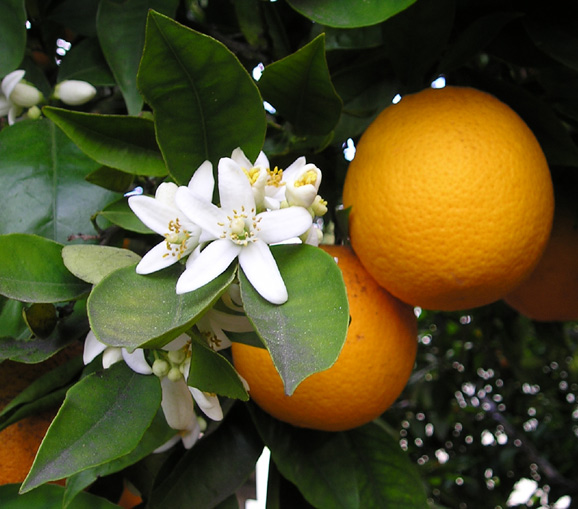
Looking at other biotic factors I noticed what the orange tree itself had to offer.  Of course the tree itself is living and there are marvelous white features on it known as flowers.  However, in addition to the beautiful white flowers I noticed some leaves had small white spots on them.  At first I believed it to be bird droppings and when I later looked closer I realized that they were not.  After I regained access to human technology and the internet I discovered that this may be a type of fungus.  Since, I live in Loma Linda this is actually not uncommon and many other households would have the same type of problem.  Alas, it is a problem that should be taken care of otherwise our oranges, which are among the best I have had, might face problems.  Looking at the ground there was a single orange that fallen some time ago.  Inside the orange there was a type of black fly which, again looking at the internet, may be fungus gnats a type of fly.  Obviously if a fruit is decomposing then there is going to be bacteria which is an addition to the biotic factors of the yeard.

http://www.olyrose.org/images/Anthracnose-2.jpg

http://upload.wikimedia.org/wikipedia/commons/b/b0/OrangeBloss_wb.jpg

While I may have not found the answers to the universe during my time in the back yard I sure did enjoy the fresh air and the citrus aroma which flew with the wind.  A beautiful bird with a blue tail landed on the top of a fence not close to me, unfortunately I was not able to take a picture of it but I was able to enjoy its company and was made aware that due tot the presence of so many different types of organisms such as insects and birds, at the very least my backyard was alive and possibly even thriving.  I had producers such as the orange tree and grass present.  I had primary consumers such as insects present.  Birds could be considered secondary and even tertiary consumers.  Finally, we had detrivores such as bacteria present.

So to sum up my experience some of the abiotic and biotic features present in my back yard are:

Abiotic:
-Plastic
-Red Bricks
-Air & temperature
-Rocks
-Dirt
-Sunlight
-Fence
-Water Hose

Biotic
-Grass
-3 Spiders
-1 Cockroach
-5 Grasshoppers
-7 Birds
-10s of Ants
-Orange tree
-Bacteria
-Fungus
-Oranges

The picture above were not original but a accurate description of what I saw.  They were provided by:
http://www.olyrose.org/images/Anthracnose-2.jpg
and 
http://upload.wikimedia.org/wikipedia/commons/b/b0/OrangeBloss_wb.jpg

Tuesday, March 11, 2014

Protecting the Safety of our Mouths

The fight over global warming, for most people, is only about arguing whether it exists or not.  However, many do not consider whether global warming exists or not we are undoubtedly experiencing weather conditions which we had not anticipated.  Due to the lack of preparedness human populations are facing problems which may not effect us directly or immediately, however, they ultimately cause the degradation of human development.  An article written by Oxfam International in 2012 focuses specifically on how extreme weather influences food production and the ability to feed millions.  Some points that the article makes are:
-The United States is a vital component of the world's production of corn and maize.
-A drought in USA in 2030 could raise food prices by nearly 100%.  Drought and/or flooding in southern Africa and India would raise prices on importing countries and leave millions without food.
-Extreme weather can eliminate harvests altogether.
-Food discussions are not heavily debated in current climate talks.

If we were to look further into the situation we could see that extreme weather in key locations such as the United States of America could cause global famine as the US is one of the biggest exporters of food to malnourished nations.

Now how do we know that we can trust Oxfam in providing accurate information?  Oxfam International is an Non governmental organization.  It is a reliable source of information because Oxfam is internationally reputed to bring attention to worldwide poverty and issues which affect the most vulnerable.  If we were to dig into the financials of Oxfam, specifically their annual report, we can see that Oxfam is not heavily funded by any specific country or corporation.  This means that Oxfam would not be biased towards any entity.  Oxfam is over 60 years old and is present in about 90 countries.  All information of their projects and how funding is used can be easily located on their website.  All these factors combined make Oxfam a reliable source for information.

There are many claims which may sound to be unbelievable.  How does Oxfam arrive to statements such as,  "Between 2010 and 2030, average world market export prices for maize could rise by 177%, with up to half the increase due to climate change".  One thing to point out is that there are no definitive statements. Instead words such as "could" and "may" are used.  Why is this?  The main reason is that Oxfam is predicting about what the world may have to experience in the year 2030.  The information provided by Oxfam is also heavily reliant on forecast models. These models have been created by using information collected over the past few decades such as what affect previous droughts have had on the world's production of food.  In addition. Oxfam references studies and sources done by organizations such as the Food and Agriculture Organization of the United Nations.  Yes, the results in 2030 may not be as severe as what may happen.  However, Oxfam has given their worst case scenarios and have also listed what factors go into these forecasts.  For example, if the world's population were not to increase as rapidly as studies indicate then the food problem would not be as severe.

After reading this article I am in dismay.  Despite the tremendous amount of technology we are still insufficient in providing hundreds of millions with proper nutrition.  In fact, even many in the United States suffer from the lack of proper nutrition.  However, after reading this article there is some hope that humans all over the world can be fed.  While there may be little to nothing that we can about changing climate and extreme weather conditions, there is much that we can do to safeguard access to food.  If we are to protect our agricultural capacity it is important for governments to truly come together and reduce dangerous pollutants and use existing ways to boost the production of clean agriculture.

The original Oxfam article and the report it pertains to can be found at the inks below:
-http://www.oxfam.org/en/grow/pressroom/pressrelease/2012-09-05/food-price-spikes-will-get-worse-extreme-weather-climate-change
-http://www.oxfam.org/sites/www.oxfam.org/files/20120905-ib-extreme-weather-extreme-prices-en.pdf

Tuesday, March 4, 2014

Chemical Take Over in the Household

Technology bring out many inventions that change the world for the better.  However, along with this change we see product sold into the market that are dangerous for our bodies.  Companies are pressured to use chemicals which can be harmful to humans in order to keep costs low, be competitive, and deliver a product which ultimately gets the job done.  Many chemicals which can be potentially harmful are included in products that we use everyday, among these chemicals are Pyrithione Zinc and Acetone.

Pyrithone zinc is a product used in multiple shampoos such as the widely used Head and Shoulders.  This chemical mainly helps with the removal of dandruff.  For some people Pyrithione zinc can be an irritant and cause allergic reactions such as rashes and swelling.  In laboratory testing on animals pyrithione zinc has shown to damage immune systems.  Well dandruff remains a problem, but Pyrithione zinc is not necessary to remove it.  Other cost-effective and natural methods exist such as using lemons.  Lemons can be grown in one's backyard or bough for a very low price at the local farmers market.  They will leave no artificial residue and hair will be just as healthy if not more healthier than if an artificial shampoo is used.

Acetone is another product which many of us to remove unwanted substances.  Acetone can be found in nail polish remover, paint remover, and dish washing material.  Acetone can cause dryness, dizziness, nausea, and even coma.  In fact, that is why kids are recommended to stay away from nail polish remover and in movies people are seen using acetone products as a way to "get high".  There have been many cases of acetone abuse or misuse reported in hospitals.  Some natural methods, again, using lemons along with vinegar to create a solution to dissolve some substances.  This is actually beneficial when using it for uses such as fingernails because not only is it natural but also because it can strengthen the local body parts.  Toothpaste, is another item which can be used to take off nail polish and other substances.  Using toothpaste such as Arm & Hammer are especially beneficial due to the heavy use of baking soda which is an effective dissolving solution.

For many decades American society has been relying on using artificial products in order to cure common problems.  These chemicals end up being more expensive to the consumer than natural methods such as lemons and the chemicals have more side effects.  There is hope as consumers are becoming aware and there has been a push to use and consume more natural substances.  Eventually we will seen cleaner products on the market which are affordable for all.  For now we must remain educated on various use of chemicals and use best practices to mitigate the effects of them.

Tuesday, February 25, 2014

The world's population is over 7 billion and each and every one of us has a unique story. Over one decade and nine years ago I was born in the state of Punjab in India.  I moved to America shortly after when I was three years old.  For those that get all their information from Slumdog Millionaire let me assure you that the environments of these two countries is quite vast but not exactly in the ways you may think.  After moving to America I moved about 13-15 times till where I am today and in these periods of residence I was able to travel all throughout California and lived in places ranging from Berkeley to Long Beach.

My major is economics and I love studying about politics, how money is transferred, and the correlation between money and major events.  I intend to have a career in finance and eventually retire at age 30, though I highly doubt that is going to happen.

So going along with my major some of my hobbies including trading stocks which so far have been a little nice to me and have driven me crazy.  I also love travelling.  As part of the Model United Nations team on campus I was able to go to Chicago, South Korea, and hopefully in a few months New York.  Aside from my travels to India I have been fortunate enough to make small stops in places such as London, Tokyo, and Dubai.  The diversity in South California is very diverse and for the past few Sundays I have tried to keep myself busy exploring the diversity of different cities with my friends.  I am also open to trying new activities, for example I hope to go skydiving in the summer.

My interest in Environmental Science started in the sixth grade when we were first introduced to this topic.  In Model United Nations many of the topics I had to research were related to political solution to the environment and why we always fail to make significant progress in mending our ways.  So for this reason and many others I decided to educate myself even further on our local and international environment.

The question I would most like to explore in this class is, if the world were to suddenly become clean would we be able to make a substantial positive impact on our environment?

Currently if everyone on planet Earth lived like me then we would need 4.3 Planet Earths to provide enough resources.  The biggest part of my impact is Services which accounts for 46% of my total ecological footprint.  The only major change I could make to my lifestyle is to purchase products that used less packaging or were made out of 100% post-consumer recycled content material.